Changing the state
The game logic changes the state only through the Table that setup and apply_action receive. Each Table method records the change for the match's history and animations. Read the state at any time with table.state().
If apply_action returns Err, every change the call made is undone, including its log lines and its allow_undo.
Maps
| Method | Does |
|---|---|
set(of, key, value) |
Sets one key of a map, or removes it when value is None. |
write(of, &value) |
Replaces a whole map with your serde type. |
update(of, |value: &mut T| ...) |
Reads a map as T, changes it, and writes it back. |
of is a StateOf (The state). write keeps a field that serializes as null; add #[serde(skip_serializing_if = "Option::is_none")] to remove the key instead.
Pieces
| Method | Does | Returns |
|---|---|---|
add_piece(space_id, piece) |
Puts a piece at the end of a space. | its index |
insert_piece(space_id, index, piece) |
Puts a piece at index. Later pieces move up. |
|
remove_piece(space_id, index) |
Takes a piece out. Later pieces move down. | the Piece |
move_piece(from, index, to) |
Moves a piece to the end of to, which may be from. |
its new index |
move_piece_to(from, index, to, to_index) |
Moves a piece to to_index, counted after the piece has left from. |
|
shuffle(space_id, rng) |
Shuffles a space's pieces. | |
set_public_kind(space_id, index, kind) |
Changes what everyone sees, such as turning a card face up. | |
set_private_kind(space_id, index, kind) |
Changes the hidden part, or removes it with None. |
|
set_piece_owner(space_id, index, owner) |
Gives a piece an owner, or removes it with None. |
Every piece method changes indexes in the spaces it touches (A piece has no id).
Spaces
| Method | Does | Returns |
|---|---|---|
add_space(space) |
Adds a space and its pieces. Panics if the id is taken. | its position |
remove_space(space_id) |
Removes a space and its pieces. | the Space |
set_space_owner(space_id, owner) |
Gives a space an owner, or removes it with None. |
Turns
set_active_players(ids) sets who may move next. Set it in every step that changes whose turn it is. End the game with is_game_over, not with an empty list: an empty list leaves nobody able to move.
Movements
Table records a movement for the client to animate. The game logic does nothing extra.
| Movement | Recorded by |
|---|---|
Added |
add_piece, insert_piece, and add_space for each piece it holds |
Removed |
remove_piece, and remove_space for each piece it held |
Moved |
move_piece, move_piece_to, and set_piece_owner or set_space_owner when they change who sees a piece in a collection |
Flipped |
set_public_kind, when the kind changes |
Shuffled |
shuffle |
set_private_kind records none. The client reads the movements with useLastChange. For animations between displayed boards, including Back and Forward, use useBoardTransition (Directional animation).
Log lines
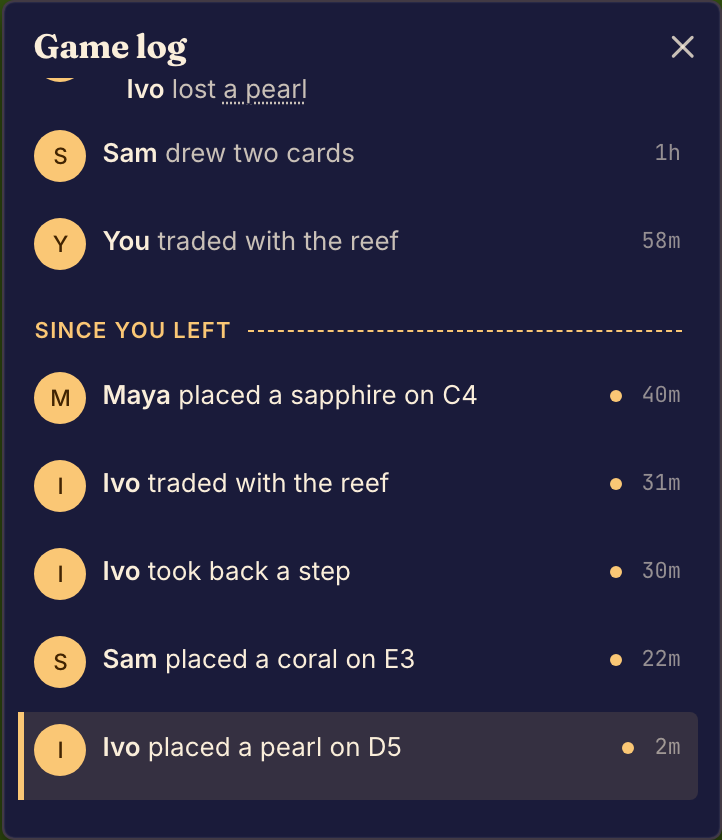
table.log(line) adds a line to the step's log, which every viewer sees in the match's history. A step may write several lines, and so may setup for the opening. A line is a message: a key in the game's catalogs (Text in the player's language) and the values of its placeholders. Each viewer's client shows it in their own language. Build a message with msg! and log it as a line by the seat that took the step:
table.log(msg!("log.marks", cell = space_id.as_str()));
table.log(msg!("log.plays", card = link(face.clone(), msg!(format!("card.{face}")))));
Write each message in the catalog of the game's default locale, such as /src/i18n/en.json:
{
  "log.marks": "{player} marks cell {cell}",
  "log.plays": "{player} plays {card}"
}
Boardweaver fills {player} with the line's player, shown by name. Leave {player} out of a message that names no one. Import msg, link and player from boardweaver_sdk.
The build checks every msg! whose key is a string literal against the default catalog. Each of these fails to compile, with the error at the msg!:
- a key the catalog lacks;
- a value its message has no placeholder for;
- a placeholder no value fills;
- a tag, such as
<b>; - a value named
player.
The build does not check a key built at run time, such as msg!(format!("card.{face}")). When no catalog has it, the line shows as its key.
A placeholder takes one of these values:
| Value | Write | Shows |
|---|---|---|
| a number | count = 2, an i64, i32, u32 or usize |
the number in the viewer's language. Count with it in a plural: {count, plural, one {# card} other {# cards}} |
| text | name = "Ys", a &str or a String |
the text as it is, in every language, such as a name a player typed |
| a seated player | target = player(id) |
the player's name |
| another message | card = msg!("card.knight") |
that message in the viewer's language, such as a card's name |
| a link | card = link(key, msg!("card.knight")) |
the message as a control that useLogLinks hears. key is your own string, such as a card id |
To give a line another player, no player or a kind, build it with LogLine::new(message) and these methods. Import LogLine and LinePlayer from boardweaver_sdk.
| Method | Sets | Default |
|---|---|---|
.player(LinePlayer::Seat(id)) |
whose line it is, which {player} names: LinePlayer::Actor, LinePlayer::Seat(id) or LinePlayer::None |
LinePlayer::Actor, the seat that took the step |
.kind("combat") |
a label the client styles the line by: 1 to 32 characters of a-z, 0-9 and - |
none |
table.log(LogLine::new(msg!("log.round", round = 2)).player(LinePlayer::None));
- Every viewer reads every line, whatever they may see of the state. Name only public facts: "takes a card", never the card. This holds for the message, its values, the link keys, the kind and the player.
- A line with
LinePlayer::Nonewhosemsg!has a literal key and a message that places{player}panics, since there is no player to fill it. With a key built at run time, the line shows as its key instead. - Write a line in each step that players should see as its own row in the game log. A step that writes no line joins another row (Other players' steps).
player(id)andLinePlayer::Seat(id)name a seated player. Any other id panics.- A
Messagegiven a value namedplayerby.argpanics: Boardweaver fillsplayeritself. - On the opening, give a line that uses
{player}aLinePlayer::Seat(id).LinePlayer::Actorhas no player there, because no seat took the opening, and the line shows as its key. - A step's lines have limits (Builds, limits and errors). Going past one panics.
Undo
table.allow_undo() marks the decision this step belongs to as one the seat may take back after it is committed. One call in any step of the decision is enough. Boardweaver's Undo takes back one step at a time, and reopens the rest of that decision as the seat's draft.
- Only a decision that ended with a
confirmstep allows Undo after commit. A decision that ended by drawing randomness or by a reveal needs a friendly takeback instead. - Draft steps not yet sent can always be taken back, with or without
allow_undo. - Undo stops at another seat's committed decision.
Friendly mode
Friendly mode is on by default in a live match. The host can turn it off in the lobby before the match starts.
In friendly mode, Boardweaver shows Request takeback outside the game client. An approved takeback restores the state before the requester's latest committed decision, and removes the moves other seats made after it. It needs no allow_undo, and it can go back past a reveal or a random draw.
- Play pauses while the opponents decide. Every human opponent must approve. Bots approve automatically, and an opponent who is away does not.
- A rejection, or a cancel from the requester, resumes the match unchanged.
- A request and its approvals survive a reconnect.
- On approval, Boardweaver discards every seat's unfinished draft and records the rewind in the history.
- Players still know what a reveal showed. A random step played again draws new randomness.
- A finished match takes no takeback requests.
Keep allow_undo and your client's Undo button for an undo that needs no approval. The studio preview and MCP play sessions offer only Undo, because takebacks exist only in live matches.